Chinese herbal medicine
Herbal medicine is one of the cornerstones of Traditional Chinese Medicine. At our clinic in Corby, we choose your herbs individually, based on your TCM assessment, and adjust them as your treatment progresses. We stock around 80 classical formulas in tablet form and more than 200 dried herbs from trusted suppliers.
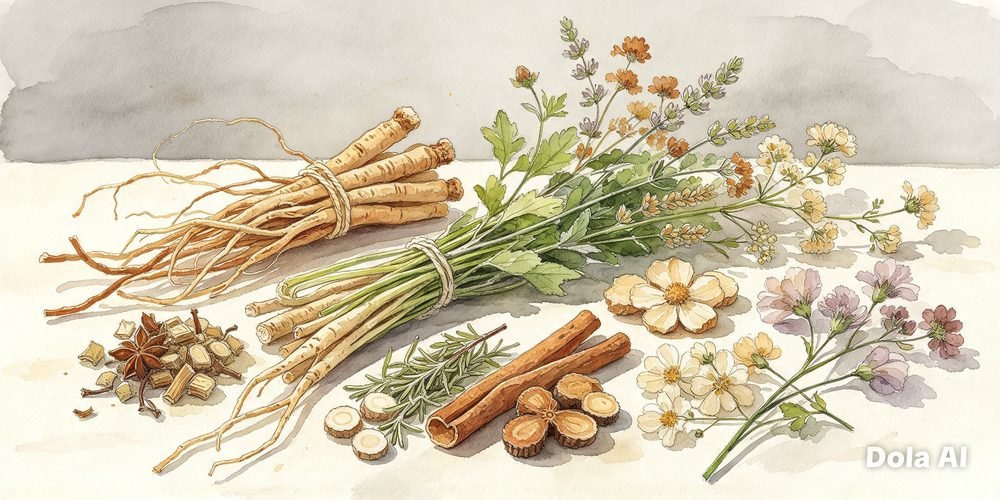
What is Chinese herbal medicine?
Chinese herbal medicine has been developed over more than two thousand years. It uses the roots, bark, fruit, seeds, leaves and flowers of plants. Herbs are rarely used on their own. They are usually combined into a formula, in which each herb has its own role and together they form a balanced whole.
Many of the formulas we use are classical prescriptions, recorded in early Chinese medical texts and used for centuries. We adapt them to you: to your TCM assessment and to how you are at the moment.
How Chinese herbs are understood in Traditional Chinese Medicine
In TCM, each herb is described by its nature (warming, cooling or neutral), its taste and the way it acts in the body. This allows us to put together a formula that aims to restore balance: warming when there is too much Cold, cooling when there is too much Heat, and strengthening when your energy is depleted.
Herbs are taken every day, so they continue to support your treatment between appointments. That is why they are often combined with acupuncture.
What form do our herbs come in?
We prescribe herbs in two forms. We decide which is right for you after your consultation, taking into account your TCM assessment and what will be easiest for you to take day to day.
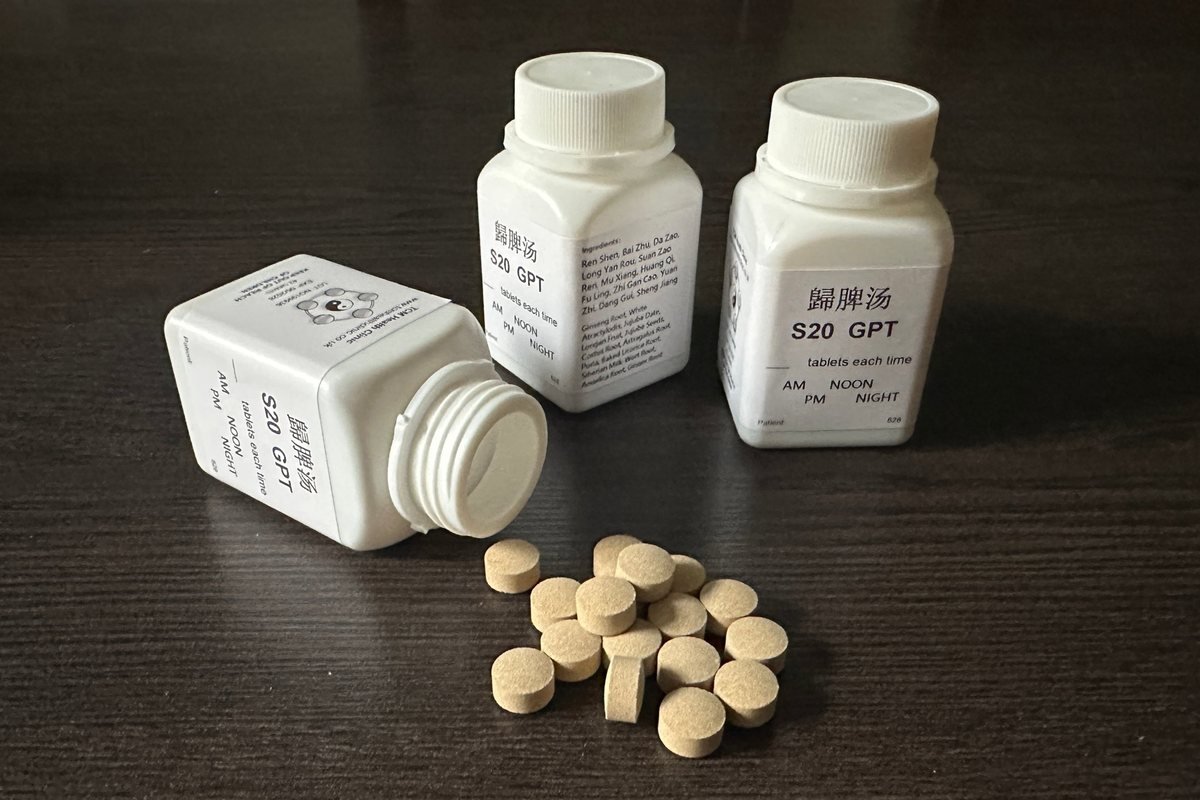
Concentrated herbal tablets
We offer around 80 classical formulas as small tablets. They are made from granules, a concentrated powder produced from the herbs. The granules are made by Sun Ten in Taiwan, one of the leading manufacturers of Chinese herbs, with 80 years’ experience, and the tablets are then produced by the British company Herbprime.
- Convenient: nothing to brew or boil.
- Easy to take to work or when you travel.
- Consistent quality from batch to batch.
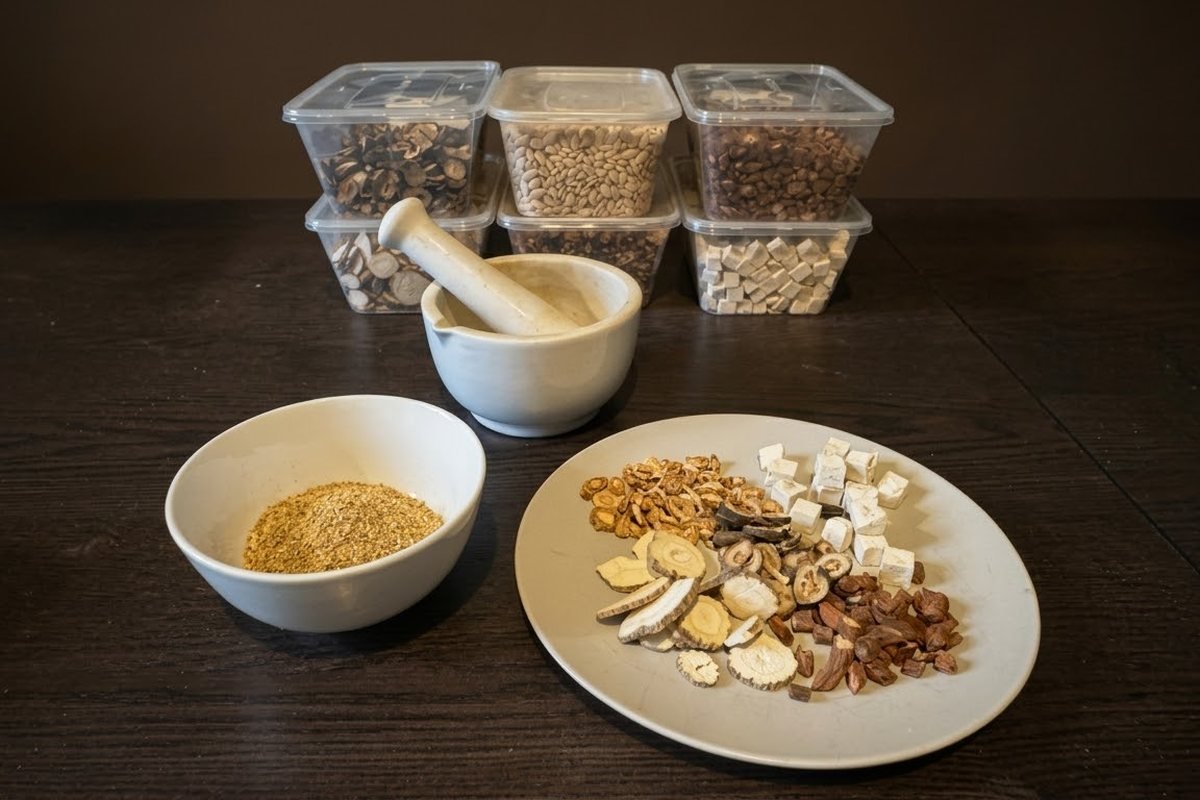
Dried herbs to brew at home
We stock more than 200 single herbs as dried roots, bark, twigs, leaves, flowers and fruit. From these we make fully personalised blends: we choose each herb and its proportion specifically for you. We grind your blend into a powder, which you then steep in a mug at home. Our dried herbs come from the British company Phoenix Medical.
- The most flexibility in choosing herbs and proportions.
- Your blend can easily be adjusted from one appointment to the next.
- The traditional form, used for centuries.
Where do our herbs come from?
We work with two established suppliers who serve professional Traditional Chinese Medicine practitioners across the UK and Europe. They apply strict quality control to the growing, harvesting, drying and processing of their herbs, from the field to the finished product.
Every batch is tested
The herbs are laboratory-tested for heavy metals, pesticides and microbial contamination, among other things. Each batch comes with a Certificate of Analysis.
Herbprime and Sun Ten
Herbprime was founded in 2006 and is the sole distributor of Sun Ten in the UK and Europe. Sun Ten oversees its herbs from cultivation to the finished product, and every batch can be traced back to its raw materials.
Phoenix Medical
Phoenix Medical is ISO 9001 certified and sources its herbs from certified farms (GAP) and from facilities that work to GMP standards. It also supplies herbs for clinical research in the UK.
You can read more about their quality control on the suppliers’ websites: Herbprime, Sun Ten and Phoenix Medical.
From our herbal dispensary
A few examples of the herbs and classical formulas we use in the clinic. We describe them here in the traditional language of Chinese medicine, where organs such as the Liver, Spleen, Heart and Kidneys refer to wider systems of function in the body, not only to the physical organs.
Single herbs
Dang Gui
Angelicae sinensis Radix, Chinese angelica rootNourishes and moves the Blood. One of the most widely used herbs in TCM for women’s health.
Huang Qi
Astragali Radix, astragalus rootStrengthens Qi, the body’s vital energy, and its protective (Wei) Qi.
Gan Cao
Glycyrrhizae Radix, liquorice rootHarmonises the other herbs in a formula, which is why it appears in so many prescriptions.
Classical formulas
Xiao Yao San
Free and Easy WandererA classical formula from the Song dynasty. It eases stagnation of Liver Qi, strengthens the Spleen and nourishes the Blood.
Gui Pi Tang
Restore the Spleen DecoctionStrengthens Qi and Blood and supports the Heart and Spleen. Traditionally used for patterns that may show as tiredness and restless sleep.
Liu Wei Di Huang Wan
Six-Ingredient Pill with RehmanniaOne of the best-known classical formulas. It nourishes Kidney Yin.
We only prescribe herbs and formulas after a consultation, based on your TCM assessment. Please don’t take them without professional advice.
What does herbal treatment involve?
- ConsultationWe talk about your health, carry out tongue and pulse diagnosis, and make a TCM assessment.
- Choosing your formulaWe choose a formula and the form of herbs (tablets or dried herbs) and tailor them to you. We always ask about any medication you take, so that your herbs are suitable alongside it.
- Explaining how to take themWe explain clearly how and when to take your herbs. You’ll also find the key points below, under “How to take your herbs”.
- Follow-up appointmentsWe usually suggest weekly appointments. Each time, we review your progress and adjust your herbs to how you are that day, because your body changes and your treatment changes with it. If needed, we can also prescribe herbs for a longer period.
How to take your herbs
We always explain how to take your herbs at your appointment. The key points are set out below, so you can easily check them again at home.
Dried herbs
We grind the herbs in your blend into a powder. This makes them easier to brew and gives a stronger infusion.
- Measure out a dosePut one dose of the powder into a mug (about 250 ml). Kitchen scales give the most accurate measure. 10 g is roughly one heaped tablespoon.
- Add water and stirPour hot water over the herbs and stir well.
- CoverCover the mug, for example with a saucer, and leave it to cool.
- Strain and drinkOnce it has cooled enough to drink comfortably, strain it through a small sieve and drink the liquid. You can throw away the residue.
We usually recommend: 10 g of powder in the morning and 10 g later in the day.
Tablets
Take the tablets with lukewarm or warm water. Please don’t take them on an empty stomach, as this can cause brief, mild stomach discomfort.
We usually recommend: 6 tablets twice a day. This dose is equivalent to 3 g of concentrated herbal powder.
When should I take them?
This applies to both forms. Take your first dose in the morning, ideally with breakfast, and your second in the afternoon or evening, unless we advise otherwise.
What’s on the label?
Every pack shows how to take the herbs, the full list of ingredients (herb names in pinyin and English), the expiry date and the batch number.
Your safety and wellbeing
We always ask about your medication
Some herbs can interact with medication. So before choosing your formula, we always ask about all the medicines and supplements you take.
We check how you’re getting on
At every appointment we ask how you have been feeling on your herbs. If something doesn’t suit you, we change your formula.
Please let us know before you start treatment if you:
- are pregnant, might be pregnant or are breastfeeding
- take any medication, especially blood thinners, heart medication, diabetes medication or hormonal medication
- have a liver or kidney condition
- have an operation or procedure planned
- have any allergies, including food allergies
Please don’t stop or change any prescribed medication without talking to your doctor. If you feel worse after starting your herbs, stop taking them and get in touch with us. In an emergency, for example if you have difficulty breathing, swelling of the face or a severe allergic reaction, call 999. For urgent medical advice, call NHS 111. Traditional Chinese Medicine complements care from your GP or medical team, but does not replace it. We encourage you to keep your GP informed about any herbs you take.
Frequently asked questions
How much do the herbs cost?
Your first appointment with 7 days’ supply of herbs costs £44, and follow-up appointments cost £34, including the consultation. A 7-day supply is two bottles of tablets or one supply of dried herbs. It costs less when combined with acupuncture. You’ll find full details on our prices page.
How long will I need to take herbs for?
That depends on what you’d like help with and how long it has been going on. We usually see you once a week, review your progress and decide together on the next steps.
Can I take herbs alongside my medication?
Often, yes, but we always need to know what medication you take, so that we can choose a formula that is suitable alongside it. Please don’t stop taking any medication without talking to your doctor.
Can herbs have side effects?
Herbs that have been carefully chosen for you are usually well tolerated. Some people notice mild digestive upset at first. If anything worries you, stop taking them and let us know.
What do the herbs taste like?
An infusion of dried herbs can taste bitter or earthy. Tablets are swallowed with water, so you’ll hardly notice the taste.
Can I have herbs without acupuncture?
Yes, Chinese herbal medicine can be used on its own. Herbs and acupuncture complement each other, though, and are the two main pillars of Traditional Chinese Medicine, so we often use them together. This combination costs less as a package. You’ll find full details on our prices page.
Not sure where to start?
Give us a call or send us a message. Tell us a little about what you’d like help with, and we’ll let you know whether we think we can help and what your first appointment will involve.